
Online Therapy Games for Focus and Connection
Prompt-based virtual games that keep kids engaged and move teens past “I don’t know.”
What do you do during a virtual session when your 8-year-old keeps getting distracted by toys off screen or your teen client just answers "Good," "Fine," or "I don't know" to every question?
I have found one thing to work, nearly every time: online therapy games. I don't necessarily mean virtual Connect 4 or games of Minecraft, although there can be a place for those too.
I use online therapy games made specifically for counseling sessions — those that combine random chance elements with goal-oriented prompts. Below I'll walk you through my favorite games here on OnlineTherapyTools.com along with how I introduce games in sessions, my clients' typical impressions, and how to use the technology itself. (If you're worried about that, it's probably much easier than you think!)
By the way, I'm so glad you found this post because it's going to make a difference! Honestly, I would no longer do online therapy for teens without these tools.
Visit here to jump ahead and try the games for yourself!
Therapeutic Evidence Supporting Online Therapy Games
First, let's look at the evidence so you're not worried that you're just killing time in session. Sometimes we shy away from activities that feel too fun in sessions because it doesn't seem like the "real" hard work of therapy. In actuality, your client may get more meaning out of a fun and engaging session than a dry one.
Get the idea and want to skip this section? Head down to the list of games below.
Believe it or not, there have been in-depth studies on the use of "video games" (although I think that term can be a little misleading) in sessions. Several games have been developed specifically around cognitive behavioral therapy (CBT), incorporating goals like cognitive restructuring into the game itself.
One group of researchers (Lim et al., 2025) concluded that while unstructured video games continue to carry risks such as distraction and overuse, purpose-driven games (sometimes called "serious games") — ideally with involvement or oversight of an adult — offer educational and therapeutic benefits comparable to traditional therapeutic methods.
Another review looked at multiple studies and found solid evidence that video games can help with depression symptoms (Ruiz et al., 2022). Elements of engagement and activation can be a great first step in recovery.
Board Games in Therapy
Since some of the online therapy games we're going to look at are inspired by board games, I wanted to touch on that theory and research as well. One review (Noda et al., 2019) found that use of board games in therapy helped with multiple areas including:
- Increasing knowledge
- Helping with executive functioning
- Improving social skills and interpersonal interactions
- Lowering symptoms of anxiety and depression in some populations
Online Games to Use in Therapy
So, now that we know the background and the benefits of online games, are you ready to give it a try? Here are several prompt-based online therapy games that can help with specific goals such as cognitive restructuring, dealing with anxiety, building coping skills, anger management, improving depression, and more!
Feelopoly City
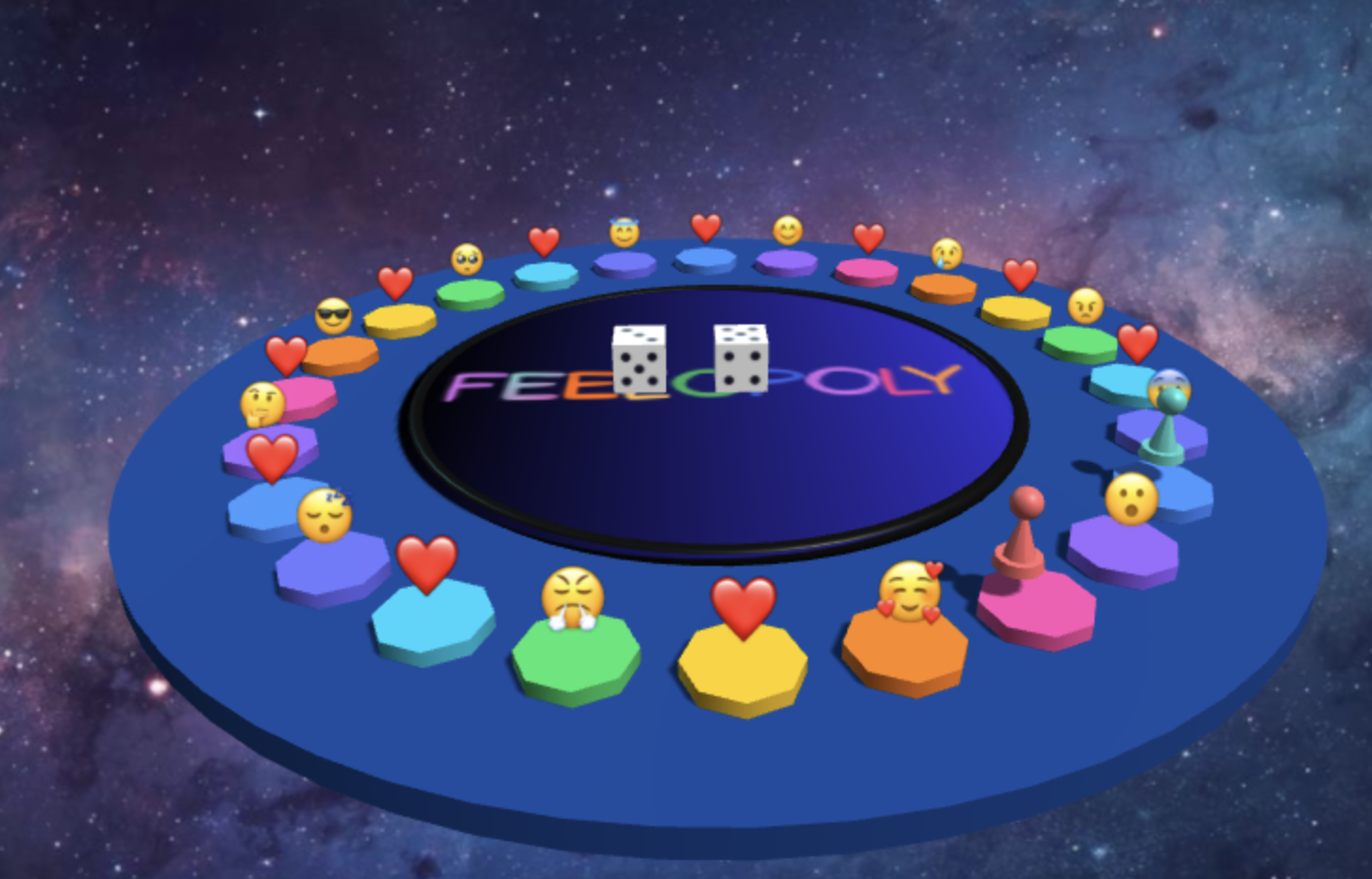
This is by far the most popular therapy game among my own clients. Feelopoly City is inspired by the mechanics of Monopoly, but incorporates discussion questions. The great thing is that you and your client can choose the theme. There are card decks for coping skills, anxiety, self-esteem, and even depression symptoms.
And for variety, your client can also choose the board game color and the setting. This helps if you play the game often so sessions don't feel repetitive.
To glance at the game it may look a bit complicated because it has the look of a physical board game, but not to worry, because the game automatically takes care of the mechanical parts. You or your client click "Roll," and the pieces will move and pull up a prompt. That might be a discussion question such as, "What's one thing that used to make you anxious but doesn't now?" or a direction such as a property card (i.e., "Angry Alley") you can choose to buy or not.
The game keeps the score, alternates turns, and shows you points. The only physical interaction you take is to roll or close a question/prompt popup on screen.
Meanwhile, your client is having fun while discussing complex topics that suddenly feel fun as well as challenging. The random element improves interest and attention while you get to work towards goals like improving mood regulation or increasing self-awareness.
Feelopoly (Cooperative Version)
Before Feelopoly City there was the original cooperative game, Feelopoly. Rather than competing, players work together to collect all of the feelings on the board as they take turns answering prompts. It promotes emotional awareness, empathy, and validation of self and others — with a gentler, more nurturing vibe than its City counterpart.
My clients and I tend to mix up the two versions depending on the session. The overall purpose is the same: discussion, connection, and a little fun along the way. If Feelopoly City feels like a lot for a particular client, the cooperative version is a natural and easy starting point.
Humans Against Stress Card Game
These are some of the more popular card-based therapy activities on Online Therapy Tools. They follow a simple format: a scenario is paired with different responses, and the client chooses the one they relate to most (or find most entertaining). That choice becomes the starting point for discussion.
For online use, you can:
- Share your screen and go through the cards together
- Or have your client open the activity and share their screen
Even though the format is playful, it leads easily into meaningful conversation:
- "Which one feels most like something you'd actually do?"
- "Which response would actually help?"
- "What would your version of this be?"
The humor lowers defenses, especially with teens, while still giving insight into coping patterns. You can use the activity as a general discussion game, or even play against each other for points.
There is both a Humans Against Stress version and a Kids Against Stress version available at Online Therapy Tools, so you have options depending on the age group you work with.
Virtual Tumbling Prompts (Jenga-Style Game)
A digital tumbling blocks-style game adds movement and unpredictability to telehealth sessions, which can otherwise feel a bit static. Each block connects to a prompt — warmup, coping skills, CBT, DBT, emotions — or you can run it without prompts and guide things yourself.
The game runs with a secret trap block and winning block, so clients are searching for the winning block while playing. This gives the game a natural arc and keeps clients invested. It also means rounds are fairly quick, so you can play multiple games in a single session without it dragging. The randomness helps it feel more like a game and less like a series of prompts.
Virtual Sand Tray
Virtual sand tray tools recreate expressive play in an online format, allowing clients to build scenes and explore emotions visually. Online Therapy Tools offers two options:
Basic Drag-and-Drop Sand Tray
- Simple and easy to use
- Works well on mobile or with younger clients
- Good for quicker or more straightforward sessions
- Includes some simple drawing features
3D Interactive Sand Tray Explorer
- Allows digging, moving, and shaping realistic sand
- Clients can bury and uncover items
- Creates a more immersive, layered experience
- Includes custom sand colors, backgrounds, and a more robust miniatures collection
Both can be used open-ended, with prompts or themes, or as part of a larger activity or discussion. Although not technically a game, I find that mixing expressive activities with games works great for online therapy sessions. Read more about the 3D Sand Tray Explorer here.
Jeopardy-Style Therapy Games
Jeopardy-style games are one of the most effective ways to combine structure, engagement, and psychoeducation in telehealth. The built-in online versions at Online Therapy Tools require no app or download — just open and play.
The games are organized into categories with increasing point values, but instead of trivia, they focus on things like:
- Emotional awareness
- Coping strategies
- CBT concepts
- DBT skills
Some examples of themes include:
- Big Feelings — exploring emotions and how they show up
- Attacking Anxiety — understanding and responding to anxious thoughts
- Look, It's Focus Kid! — attention, impulse control, and ADHD-related skills for kids
What makes these work well in therapy is that they don't have to be "right or wrong." The prompts can be open-ended, discussion-based, or gently guided with suggested answers. You can let the client choose categories and stay in control, or guide the flow yourself depending on the session. They're especially useful when you want a clear structure for the session, to introduce or reinforce skills, or to keep things moving with clients who lose focus easily.
Therapy Bingo
Bingo translates extremely well to online therapy sessions, especially when it's built specifically for therapeutic use.
In the digital versions at Online Therapy Tools:
- Each client gets their own digitally randomized card
- Each square brings up a prompt (rather than just a number)
- Cards are interactive and can be marked off directly online
This means clients can stay fully engaged on their own screen while you guide the session. You can use it in a few ways:
- Play toward a traditional Bingo (row, column, or blackout)
- Or use it more flexibly as a structured prompt board
As clients mark spaces, they respond to prompts related to coping skills, emotions, reflection questions, and behavioral patterns.
This works particularly well for:
- Kids and teens who like clear goals
- Clients who benefit from visual structure
- Sessions where you want steady pacing without pressure
It keeps things moving, but still allows space to slow down and explore responses more deeply.
Drawing and Pictionary-Style Activities
Drawing-based activities are simple but highly effective in telehealth. You can use the online drawing canvas available at Online Therapy Tools, or have your client draw on paper at home and show their work on screen.
This works well for:
- Kids and teens
- Clients who struggle to verbalize emotions
- Creative or expressive sessions
You can run it as:
- Pictionary-style guessing games
- Emotion drawing
- Scenario-based drawing and discussion
How to Play Therapy Games in Zoom and Online Platforms
To set up a game in session, simply log into Online Therapy Tools, share the game with your client through a private link, and share one of your screens via Zoom or another platform. Since most of the interaction is visually on screen or through discussion, one player can “host” and click the roll button while the other plays along. I typically let my clients be the host, but I sometimes do so as well.
A few tips to make it smooth:
- Practice sharing ahead of time so you’re more comfortable in the session
- Share “tabs” instead of your full screen, and have your clients do the same
- If clients struggle with links in the chat, have them copy and paste instead of clicking
- All of these games are designed so one player can host while the other follows along — it works great!
In a pinch, you can also play the games off screen. Just have your client host and read the prompts aloud. You’re still discussing and interacting — you just miss out on the visual side.
And if you really love any of the games and want the real thing? Many have printable versions as well!
Whether you're trying to connect more with clients, help them stay focused, or address specific goals, there are therapy games that can help. Start by signing up at OnlineTherapyTools.com and find the games right for you!
References
- Lim, E. C. N., et al. (2025). Serious games and purpose-driven digital interventions in mental health: A review. Journal of Medical Internet Research.
- Ruiz, R. J., et al. (2022). Video games for depression symptoms: A systematic review. JMIR Serious Games.
- Noda, S., Shirotsuki, K., & Nakao, M. (2019). The effectiveness of board games in therapeutic applications: A systematic review. BioPsychoSocial Medicine, 13(1), 22. https://doi.org/10.1186/s13030-019-0164-1
About the Author
Jennie Lannette Bedsworth, LCSW is a licensed therapist and the creator of Online Therapy Tools and The Counseling Palette, trusted sources for therapy games, group therapy activities, and printables. With two decades of experience in the mental health field, Jennie designs printable and online resources that make therapy engaging, effective, and accessible for all ages. Browse our collection of online therapy tools for meaningful connection at OnlineTherapyTools.com.